MSU Bio-Archaeology Lab
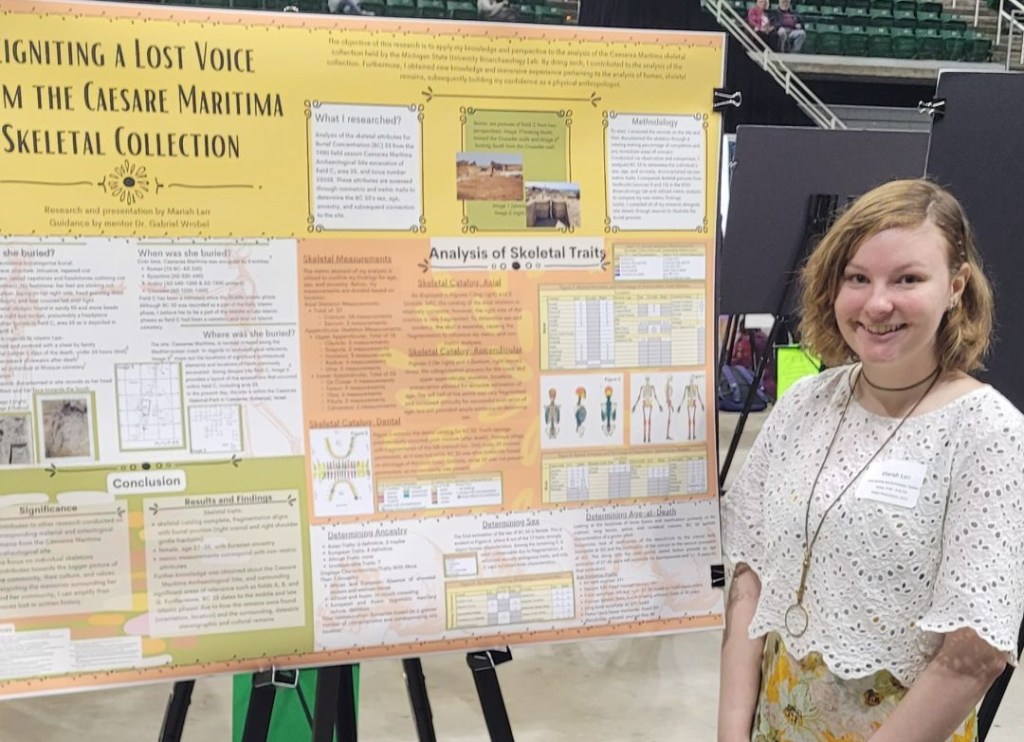
Over 40 hours of experience working with skeletal remains from the Caesare Martima Islamic site. After taking inventory of the previously documented skeleton BC33, I established the gender, age range, ancestry, and any evident cultural markers within the burial itself. Calculations of the data and skeletal indicators brought to my conclusion that the remains are female, between the age of 27-35, of mixed Asian and European ancestry, and that the burial exhibits Islamic practices and correlating timeperiod. The burial site was intentional as well, as displayed through intentional body placement, crossed legs, stone markers, and beads placed either in the eyes or as a headpiece. The cause of death is unobservable from the skeleton and she likely died of natural causes. This work was further presented at the annual UURAF awards, where I received 1st place for the anthropology and archaeology section.
Research paper: The Ethical Dilemma that has Ensnared Penn Museum
As part of my final collection of knowledge derived from my undergraduate career, the below research paper openly displays skills of deduction, analysis, and interpretation. Delving into my race and ethnicity minor greatly helped with the analysis of the ethical dilemma Penn Museum found itself in regarding the possession and research of the Morton Cranial Collection. The cause of the dilemma is the collection’s initial intention. Used to justify slavery and mistreatment of minority groups through scientific racism, the collection caused a social and political uproar within the descendent, academic, and local communities. The document below further delves deeper into the aforementioned dilemma and represents my ability to commit and accomplish research, along with comprehensively organizing my ideas that arose from said research and the collective knowledge obtained in my academic career.
 Mariah Larr